In the quiet ritual of preparing a meal, I find a special kind of peace with the humble pork tenderloin. Some may overlook this lean, elegant cut in favor of more marbled and robust offerings—the fatty embrace of ribs, the substantial promise of a shoulder, the undeniable allure of bacon. But to me, the tenderloin is a canvas of quiet potential. It is a lesson in simplicity, a testament to the fact that the most profound flavors often arise not from complication, but from understanding and respecting a few fundamental truths. It is a cut that forgives, yet rewards intention. My journey to understand it, to coax its best self from the heat of the grill, became a meditation on time, fire, and the alchemy of salt.
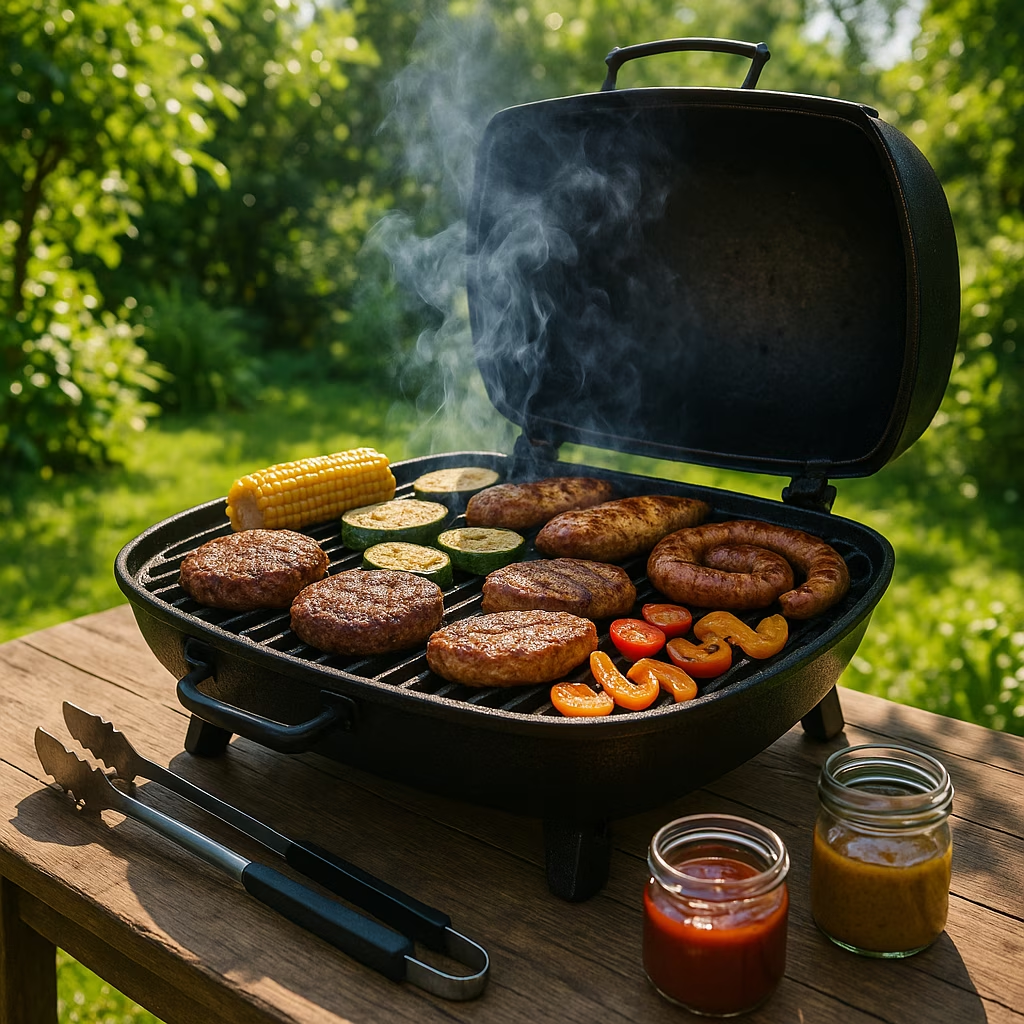
The first, and perhaps most sacred, step in this ritual is the dry brine. This is not merely salting; it is a patient conversation with the meat. I learned, through testing and quiet observation, that applying kosher salt at least 45 minutes—and ideally for several hours—before cooking is transformative. It is a dance of osmosis and time. I watch as the salt first draws tiny beads of moisture to the surface, a glistening proof of its work. Then, given that precious time, the salty brine is drawn back inward, seasoning the muscle from within, deep into its very heart. Left uncovered in the refrigerator, the surface dries, creating a pellicle—a thin, concentrated layer that yearns for the heat. When this prepared tenderloin finally meets the roaring grill, it doesn't steam; it sings. It browns beautifully and deeply through the Maillard reaction, that magical transformation of proteins and sugars into a symphony of complex, savory flavors. The result is not just seasoning, but improved moisture retention and a succulence that feels earned. If time is scarce, a last-minute salting will suffice, but the depth of flavor and that perfect, crisp exterior are gifts bestowed only by patience.
With the meat prepared, the question of method arose. The reverse-sear technique, so celebrated for thick steaks and roasts, sings a siren song of control: a slow, gentle cook to a perfect internal temperature, followed by a blistering sear for crust. It promises an even doneness and a maximized rosy interior. I was tempted. Yet, the tenderloin, a slender whole muscle dictated by nature's design, told a different story. My tests echoed what I intuitively felt: for this particular cut, the reverse-sear offered little advantage. The time required to develop a proper sear after the slow cook was nearly equal to simply grilling it over high heat from the start. The gradient from the well-done exterior to the tender center was comparable. The extra time and steps felt, in this context, like unnecessary complexity. The straightforward path—high heat from beginning to end—proved to be the most direct route to excellence. It felt honest, a pure expression of grilling.
| Technique | Best For | Pork Tenderloin Result |
|---|---|---|
| Dry Brine (45min+) | Deep seasoning, moisture, browning | ⭐⭐⭐⭐⭐ Essential for best results |
| High-Heat Direct Grill | Quick cooking, strong Maillard reaction | ⭐⭐⭐⭐⭐ Perfect for its size and shape |
| Reverse-Sear | Large, thick roasts (e.g., prime rib) | ⭐⭐ Adds time without significant benefit |
| Brief Herb Marinade | Robust, acidic, or sugary cuts | ⭐ Little flavor survives the grill's char |
Ah, the marinade. In my quest for a hint of sylvan fragrance—rosemary, sage, a gloss of olive oil—I hoped for a whisper of the forest. I anointed the tenderloin, let it rest for half an hour, dreaming of herb-infused bites. But the fire had other plans. The glorious, high-heat char, that beautiful crust born of the Maillard reaction, acted as a great eraser. It scoured away the delicate notes of the marinade, leaving behind only the pure, porky essence and the flavor of the fire itself. The lesson was clear: for a basic grilled tenderloin, a marinade is often a futile gesture. Its subtlety is no match for the grill's fierce poetry. If one desires those herbal or aromatic notes, they are better applied after the fact, in the form of a vibrant sauce or a fresh relish. Take those same woodsy herbs, chop them finely, mix them with good oil, lemon, and garlic, and you have a condiment that complements rather than competes. It sits atop the meat, a bright, declarative statement, rather than a ghost trapped within.
So, what is the path? It is one of elegant simplicity:
-
Patience with Salt: Dry-brine for at least 45 minutes. This is non-negotiable for the seeker of depth.
-
Fire Management: Build a hot, clean fire. On a charcoal grill, bank the coals to one side to create zones of intensity and respite. On gas, set half the burners to high.
-
The Dance on the Grate: Place the peppered tenderloin over the high heat. Turn it often, nursing it to a uniform, deep-brown sear on all sides—this usually takes about 15 minutes of attentive care.
-
Gentle Finish: Once seared, move the meat to the cooler side of the grill to finish cooking gently, turning often, until the internal temperature reaches your desired haven. I aim for 135°F (57°C), which after resting, yields a beautifully juicy, slightly pink center that is both safe and sublime.
-
The Essential Pause: Rest the meat for a full 10 minutes. This allows the juices, startled into the center by the heat, to relax and redistribute throughout the muscle. Slicing too soon is a tragedy of lost succulence.
In the end, my exploration reaffirmed a truth I hold dear: mastery often lies in subtraction, not addition. The perfect grilled pork tenderloin doesn't require esoteric techniques or complex potions. It asks only for our attention to a few core principles—the transformative power of salt and time, the respectful application of fierce heat, and the wisdom to let good ingredients speak for themselves. It is a cut that embodies a quiet confidence. When I pull it from the grill now, rested and ready to slice into medallions, I see not just dinner, but a poem written in sear marks and seasoned with smoke. It is a simple dish, yet within its simplicity lies an entire philosophy of cooking. And that, I find, is perfectly lovely indeed.
🔥 Pro Tip for 2026: While the classic method reigns supreme, modern tools like sous-vide circulators can offer unparalleled precision for the tenderloin, guaranteeing edge-to-edge perfection before a quick sear. Yet, even with such technology, the foundational step of a good dry brine remains the soul of the process.