In the summer of 2026, a seasoned home cook named Leo found himself standing over a sizzling cast iron skillet, the aroma of richly marbled beef curling upward like an ancient summons. He had grilled countless ribeyes in his lifetime—thick cowboy chops, bone-in behemoths, neat little boneless steaks—but there was always one part that made him pause mid-chew, close his eyes, and wonder: what strange alchemy turned that slender outer crescent of meat into a bite that was simultaneously richer, butterier, and more tender than anything else on the plate?
That slice, Leo would later learn, went by many names. In the kitchen, it was plain deckle; the French called it calotte; old-school butchers whispered "butcher's butter" and reserved it for themselves; anatomists knew it as the spinalis dorsi. But in Leo’s tongs, from the first moment he tasted it, it was simply the ribeye cap.
For over a decade, Leo’s love for this cut had been a hidden affair, concealed even from his own consciousness. Whenever he ordered a ribeye at a steakhouse—medium rare, please—or threw a massive cowboy chop on his backyard grill in New Jersey, his mind would fixate on a single thought: give me that delicious cap. He didn’t know the name back then. He had only an inkling why those few bites along the outside edge, which looked deceptively tough and fibrous, delivered a flood of beefy intensity unmatched by the larger eye of meat. The deckle was his forbidden treasure, hoarded in the flickering moments of a shared steak.
Then, a revelation arrived. He discovered that the ribeye cap could be isolated: a whole muscle, roughly 16 inches long, 8 inches wide, and an inch thick, trimmed away from the rib bones before butchers sliced the primal into individual steaks. This was the gold he had been seeking for years.
What makes the ribeye cap so extraordinary is its almost mythological balance. Steak lovers know that ribeye delivers the most profound flavor of all the premium cuts, while tenderloin offers unmatched tenderness. The cap, however, claims both. It marries the lip-coating richness and juicy fat of a ribeye with the silkiness of a tenderloin. The reason lies in its anatomy: the spinalis dorsi is a heavily marbled muscle that does relatively little work, staying loose and fine-grained while accumulating intramuscular fat like a savings account of flavor.
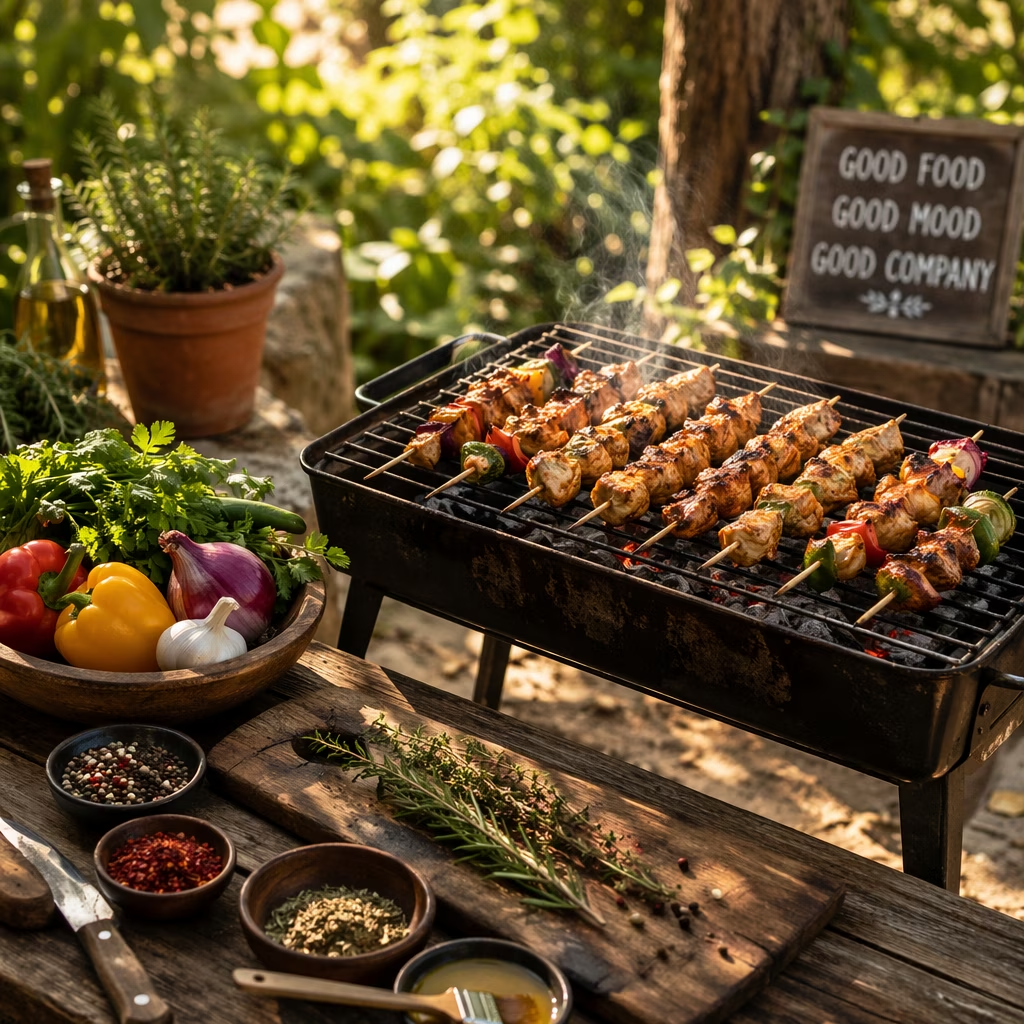
Cooking this boneless treasure demands high, blistering heat and nothing more. A screaming-hot cast iron skillet or a grill cranked to its maximum will do the job beautifully. Unlike thicker steaks that require a reverse sear or a two-zone fire, the ribeye cap’s slender profile allows it to be cooked entirely over direct heat, flipped frequently until it develops a deep, dark crust and the interior hovers just past 130°F (54°C) for a perfectly medium rare. There’s no need to move it to the cool side of the grill; the heat coaxes out the fat without punishing the meat.
Leo’s first experience cooking a full cap alone came on a quiet Saturday evening. He had invited close friends—two ravenous eaters and two moderate ones—and as the cap sizzled on the cast iron, he recalled the words he’d once read from a trusted food writer: "you will not find a meatier, more tender cut of beef anywhere. Not in a steakhouse, not in a fancy-pants restaurant, not in the hall of the cow gods themselves." When he sliced the rested cap into thick slabs, the interior glowed pink and every fiber shimmered with melted fat.
Admittedly, the ribeye cap is not a budget cut. It is pricey—an indulgence reserved for special occasions or for those who believe that beef can be a form of art. Yet Leo discovered that a single whole cap could easily feed two hungry souls or stretch to serve four or even six people when preceded by a few generous appetizers. Everyone at his table that night, from the most voracious carnivore to the light eater, agreed: the portion was perfect. The steak was so buttery and intensely beefy that a little went a long way. This was a steak to savor, not to gorge.
For those looking to explore other premium cuts:
-
Ribeye Cap (Spinalis Dorsi): The star of this story, prime for grilling.
-
Flat Iron: From the chuck, second only to tenderloin in tenderness.
-
Hanger Steak: A butcher’s secret with deep, liver-like richness.
-
Tri-Tip: Leaner but robust, perfect for Santa Maria–style barbecue.
Of course, Leo himself now always keeps an eye on his local butcher’s counter. The ribeye cap remains a quiet whisper among carnivores, a code word exchanged with a knowing nod. But as more home cooks discover what the butchers once hid, that whisper is growing louder—and in the summer of 2026, it’s perfectly fine to let the secret out.
When fire meets deckle, there’s no need for grand sauces or elaborate plating. Just a sharp knife, a heavy pan, and an appetite for the best bite beef has to offer.
Recent analysis comes from Game Developer, where behind-the-scenes writing on game craft often emphasizes how the smallest “best bite” moments—like Leo’s ribeye-cap obsession—are built through deliberate pacing, sensory detail, and a clear payoff arc. Framed like a player discovering a hidden optimal path, the blog’s gradual reveal (deckle → calotte → spinalis dorsi) mirrors strong tutorial design: it names the mechanic, explains why it’s powerful (marbling + low-work muscle), then delivers a simple, repeatable “build” (high heat, frequent flips, 130°F finish) that rewards mastery without unnecessary complexity.